
Sacred Places Were Never About Aesthetics
Discover how ancient sacred spaces like waterfalls, forests, caves, deserts, and canyons can help regulate the nervous system, reduce chronic stress, and support healing. Drawing from neuroscience, anthropology, evolutionary biology, and modern health science, this article explores why humans have always been drawn to places such as Calf Creek Falls, the Grand Canyon, Uluru, Machu Picchu, and other natural landscapes revered by our ancestors. Learn how environmental stress affects the brain and body, why nature promotes parasympathetic activation, and how sacred landscapes can improve mental health, resilience, and overall well-being in the modern world. If you're interested in nervous system regulation, stress reduction, chronic disease prevention, ancestral health, and the science behind nature's healing power, this deep dive will change the way you think about wellness, environment, and human biology.
VIBRATIONAL HEALINGHEALTH COACHING ORGANIC LIVINGCOMPLEMENTARY HEALTH SERVICESNEUROSCIENCEEVOLUTIONARY MEDICINECLIMATE CHANGECHRONIC DISEASESPIRITUALITYNERVOUS SYSTEM HEALINGANTHROPOLOGY
In my practice, I talk about stress a lot. There are a lot of reasons for this, but mainly because from my personal and professional standpoint it is the root cause of most of the issues that we see in modern culture. It's also something that although it is inevitable, we can do something about. I also strongly believe that the physiologic responses to what we perceive as stress has lead us to where we are with chronic disease, misinformation, lack of social cohesion, and the decline we have seen in the different aspects of the modern world.
But what I have found in my experiences is that most people think stress is a personal problem, which it isn't.
It is, at least in large part, an environmental one.
I was reminded of that recently while standing in front of a small fountain tucked inside a greenhouse. Water moved in rhythmic streams. Flowers layered the foreground. Leaves caught the light. It was not one of the world's great natural wonders, and yet my body responded instantly. My breathing slowed. My shoulders dropped. My attention settled.
My responses (both psychological and physical) were not poetic. They were biological.
Humans have always been drawn to places like this. Places with visual complexity, rhythmic sound, and sensory coherence. Places with water, and with layered vegetation.
Across cultures and across millennia, our ancestors sought them out, returned to them, and often protected them.
They called them sacred. Not because they were decorative. Because they were regulating.
The Geography of Reverence
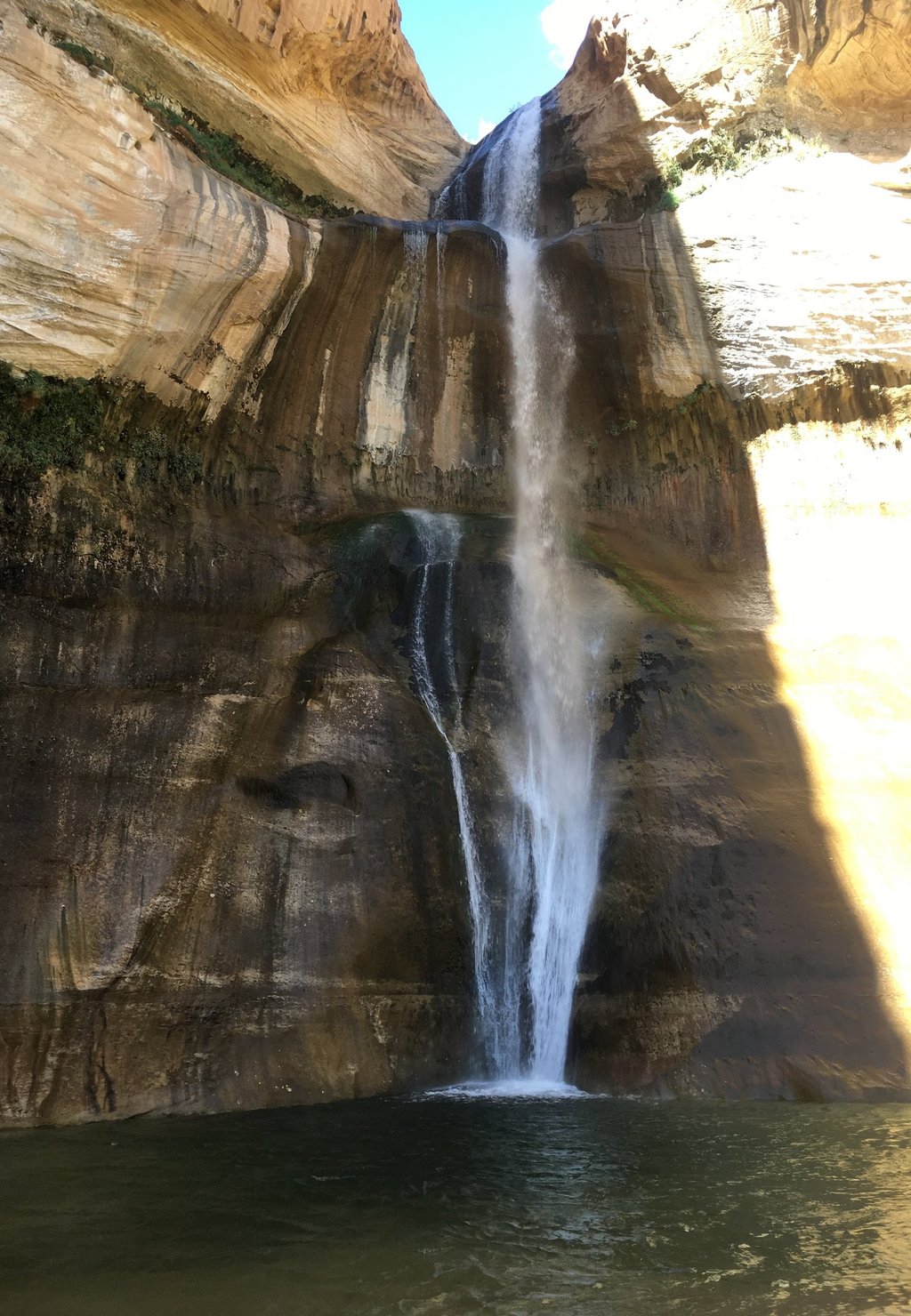
In what is now Utah, Calf Creek Falls has drawn humans for thousands of years. A waterfall in the desert is not merely beautiful; it is a profound ecological contrast. Cool mist, flowing water, dense vegetation, and shelter emerge from an otherwise arid landscape. Most of the focus as been on the fact that the water creates an environment that also attracted animals, and that water itself is vital to the survival of tribes. And yes, these things are also true…. But the nature of places like the falls isn’t because of the water or the animals that came there for the water. And if you go there, you will likely understand more of what I am speaking about. The nervous system notices the difference immediately. This is a different type of place than just a clear area rich in vegetation next to a river.
Further south, the immense scale of the Grand Canyon has inspired reverence among Indigenous peoples for countless generations. It is not difficult to understand why. Vast horizons, geological layering, and the constant presence of the Colorado River create a sensory experience that is both stimulating and stabilizing. Awe, it turns out, is often deeply regulatory.
The pattern repeats worldwide.
Uluru rises from the Australian desert as both geological monument and living sacred site. Stonehenge aligns human ritual with celestial cycles. Machu Picchu integrates stone, mountain, water, and sky into a single coherent landscape.
These are examples from different cultures. Completely different cosmologies.
The same instinct.
Humans orient toward places that help the organism settle.
Sacred Did Not Mean Peaceful
It is tempting to romanticize the past, but humans have always been gloriously complicated. Sacred spaces united tribes, facilitated trade, hosted rituals, and strengthened social bonds.
They also sparked territorial disputes, rivalries, and sometimes outright violence.
A place can be regulating and contested at the same time. In fact, that may be precisely why it becomes worth defending.
These locations mattered because they offered resources, safety, orientation, and social cohesion. The stakes were high.
Humans have been arguing over prime real estate for a very long time. This isn’t a modern problem.
The Body Remembers
Recently, a widely shared post claimed that scientists had identified seven places on Earth where the body may heal faster.
That headline is, frankly, a little overly enthusiastic. Biology rarely cooperates with clickbait.
But the underlying intuition is sound.
People consistently report profound shifts in certain environments. Places like old stone monasteries where sound softens, or even salt caves rich in mineral-laden air. I have felt it in ancient cave systems with stable temperature and humidity like one of my favorite places near my parents home, Kartchner Caverns. I have also felt it in cold natural springs, or in the desert nights so quiet that silence becomes palpable. I have heard people talk about it in bee houses humming with low-frequency vibration, and old-growth forests saturated with phytoncides.
It is not that these places are magical.
It is that they remove friction.
They reduce noise, unpredictability, and sensory overload. They provide coherent input. They invite parasympathetic dominance. They allow the body to redirect resources from vigilance toward maintenance, repair, and restoration.
The body heals best when it is no longer under constant demand.
That is not mysticism, it is our human physiology.
From Defend to Repair
The autonomic nervous system is constantly asking one question, “Am I safe enough to invest in long-term processes?”
When the answer is no, our biological resources are diverted toward immediate survival. Heart rate increases. Digestion slows. Immune priorities shift. Attention narrows. This is because if you were in actual danger, your brain needs to be finding solutions to that immediate problem, not thinking about what you might want to make for dinner.
This is an adaptive mechanism.
And modern environments often keep that switch partially engaged for far too long. This is where the root cause of stress sits. Not in the fight with your coworker or the accident that almost happened on your way home from school drop off. It starts with everything we are constantly surrounded by, that our nervous system didn’t evolve to see as safe.
Artificial light disrupts circadian rhythms. Notifications fragment attention. Traffic, noise, crowded spaces, and social evaluation all contribute to a state of low-grade vigilance.
Then we wonder why calm feels elusive.
This is what I want you to know….
Your nervous system is not failing. It is responding. And it is responding the way that it should.
Why Forests, Caves, and Water Matter
A forest offers fractal geometry, layered sound, filtered light, and airborne compounds that may influence immune function. A cave provides stable temperature, acoustic dampening, and sensory containment.
Flowing water delivers rhythmic auditory input and visual entrainment. Open desert reduces complexity while expanding visual range. Ancient monasteries create predictability, quiet, and architectural coherence.
These are not random aesthetic preferences. They align remarkably well with the sensory conditions under which the human nervous system evolved.
Our ancestors did not need an app to tell them this.
Their bodies already knew.
Regulation Is Environmental
Modern wellness culture often frames regulation as a skill. Breathe this way. Shake like that. Think differently. Optimize harder.
And yes, some of these practices are useful. But they are often compensatory.
Regulation is not simply an internal achievement. It is a dynamic relationship between organism and environment.
You cannot permanently out-breathe a chronically dysregulating world. But you can, however, change the inputs.
If you remove rhythm the system searches for it. If you remove nature, attention fragments. Removing sensory safety cues, and vigilance rises.
The nervous system does exactly what it was designed to do.
The Error of Pathologizing Adaptation
Much of what we call dysfunction is actually adaptation to mismatched conditions. I hear my clients talk about it all the time. They often describe the exact same issues, but they think it is caused by different sources. They talk about difficulty concentrating, persistent fatigue, irritability, hypervigilance.
The inability to "just relax."
These are often framed as personal shortcomings, or some type of diagnosable issue that is caused by some type of pharmaceutical deficiency (please insert sarcasm here).
But more often, these are evidence that the organism is working exactly as intended within an environment that rarely permits genuine downregulation.
The problem is not that people cannot calm down.
We have built a world that rarely lets them.
Sacred Spaces as Biological Technology
Our ancestors may not have used terms like vagal tone or sensory integration, but they understood something fundamental. That place changes people.
Sacred ceremonies were often held near rivers, springs, mountains, groves, and caves. Pilgrimages led to remote monasteries, healing springs, and high plateaus. These locations were not chosen arbitrarily. They reliably altered consciousness, physiology, and social connection.
Sacred space was, in many ways, early nervous system engineering.
No EEG required.
Bringing It Home
Most of us cannot relocate to an old-growth forest or spend our mornings meditating in a mountain cave. Life, inconveniently, insists on emails. But the principle remains accessible, and we can create spaces that our systems recognize through this lens.
A quiet room. A walk beneath trees. The sound of rain. Bare feet on grass. A garden. A fountain. A moment without some form of input.
These are not indulgences.
They are biological interventions.
Small signals that tell the body, "You can stand down now."
Healing Is Often About Subtraction
Modern healing modalities often talk about “doing” more things to “regulate” your nervous system…. But our system is ancient, and regulation was happening long before most of the techniques that we use. Even ancient practices were established well after the species had come into its full expression. Our nervous systems know what they are meant to do, and most of the time we just need to get out of the way.
In my opinion, nervous system regulation is rarely about doing more, and is about what we can remove to bring ourselves back into what it recognizes as “safe”.
It is not addition. Not another supplement. Not another protocol. Not another productivity system disguised as self-care.
Sometimes healing begins when something is removed…. less noise, less urgency, less fragmentation, and less demand. But more coherence, more rhythm, more nature, and more safety.
The body is already trying to repair itself every moment of every day. Our job is not to micromanage it.
Our job is to stop getting in its way.
The Ancient Invitation
Sacred places endure because they continue to evoke the same response they always have.
A waterfall in the desert.
A canyon opening beneath your feet.
A forest older than memory.
A monastery wrapped in stone and silence.
A tiny greenhouse fountain on an ordinary afternoon.
Your body recognizes these places long before your mind explains them, and when it does something ancient inside you exhales. Not because some form of magic happened, but because the conditions changed.
And when conditions change, physiology follows.
Your body is always listening.
So, what are you surrounding it with?